
















Modern Standard Arabic (MSA)

Learn the formal Arabic language with Playaling! Our real-world videos will help you become fluent in MSA while having fun!

Welcome to Playaling, a platform designed to help you learn Modern Standard (MSA) through real-world videos, interactive captioning, and exercises. Dive in and explore the richness of Modern Standard Arabic in a fun and captivating way!

How to learn MSA?

Learning MSA requires injecting fun into the learning process, along with considerable repetition and perseverance. For these reasons, Playaling is the ideal platform to help you learn Modern Standard Arabic.

An image with the Arabic Saying: Arabic does not just speak to the mind - it sings to the soul with its poetic struccture and rhythm!

The words and letters might initially appear as complex symbols, but as you start to learn MSA, you’ll discover they’re not as daunting as they seem. They’re quite easy to grasp, with many sharing a similar structure in their written form, differing mainly in the number and placement of dots.

To learn Modern Standard Arabic (MSA), we would suggest the following plan:

Learn the Arabic alphabet 

The Arabic alphabet consists of 28 letters, plus the hamza (ء). Beginning to learn these letters and how to write them reveals their simplicity and ease. With dedication and practice in writing and pronouncing these letters, it’s possible to learn them in just one day. This step is crucial, even if your primary objective is conversational rather than reading or writing. Familiarity with the letters and the ability to write words is a fundamental aspect of learning Modern Standard Arabic and significantly facilitates acquisition of the language.

Use your knowledge of the alphabet to learn MSA words and phrases, such as greetings, farewells, asking about well-being, expressing gratitude, and apologizing. Through the Audio Dictionary, you can learn to write, pronounce, and use any word in different contexts and situations. This dictionary enables you to search for words, hear their pronunciations, understand their meanings, and see examples of how they’re used in context.

Continuous exposure to the language

The learning process is cumulative, making it crucial to continuously expose yourself to it through listening, reading, speaking, and writing. Develop these skills simultaneously by watching real-world videos in Modern Standard Arabic and its dialects. Enhance your understanding by reading video transcripts, clicking on words to learn about them, and practicing pronunciation and comprehension with the popup dictionary. For writing, the Cloze Listen activity accompanying each video allows you to practice by filling in the blanks with the appropriate words, either by typing or selecting from a word bank.

Exploring MSA literature and the arts – including films, songs, plays, poems, and series – enables you to familiarize yourself with Arab culture and deepen your engagement with the language. Playaling offers a wide range of real-world video clips that showcase the arts and culture of Modern Standard Arabic.

Conversation and repetition

It’s essential to continually repeat what you’ve learned and to speak aloud in Arabic. This can be done with a native Arabic speaker, if available, or by speaking to yourself and repeating dialogues you’ve heard in the videos, with an emphasis on the pronunciation of the words.

Differences between MSA and Classical Arabic

Classical Arabic, also known as Quranic Arabic, is based on the language of the Quran and was prevalent in the early Islamic periods. It has been influenced by linguistic changes over time.

Modern Standard Arabic (MSA), which is used in contemporary media, serves as a standardized form across Arabic-speaking countries. Despite this standardization, cultural variations lead to specific linguistic differences among different geographical regions. These differences are primarily evident in terminology and the acceptance of colloquial vocabulary.

Linguistic content

The Quran, along with religious and philosophical literature from the Umayyad and Abbasid eras, serves as the foundation for Classical Arabic. In contrast, Modern Standard Arabic is grounded in contemporary media and modern literature spanning various fields. Content in Modern Standard Arabic may blend elements of both Classical and Modern Standard Arabic, which poses challenges for standardization due to the enduring influence of Classical Arabic.

Linguistic differences

Grammatical differences between Modern Standard Arabic and Classical Arabic include variations in syntax, morphology, sentence structures, and the use of numerals instead of traditional Arabic numerals (تَفقِيط) in contexts such as news, prices, and dates, with specific exceptions.

Terminology

Terminology represents a significant distinction between Modern Standard Arabic and Classical Arabic. The modernization of Arabic necessitates incorporating contemporary world terminology across technical, literary, and scientific fields. While there have been efforts to Arabize new terminologies, phonetic adaptation has emerged as the preferred method to accommodate modern terms.

Phonetics and diacritics

In the field of phonetics, there are differences between Modern Standard Arabic (MSA) and Classical Arabic. MSA accommodates foreign sounds like G, P, and V, with specialists differing on their Arabization. MSA tends to use only basic vowel marks for diacritics, sparking debate about their impact on reading fluency.

Punctuation

Modern Standard Arabic has adopted punctuation marks from foreign languages and abandoned some from Classical Arabic. The widespread use of modern technologies, particularly printing applications, has played a significant role in this shift. The differences can be summarized as follows:

  • Use of quotation marks: MSA favors Latin quotation marks (“أبجد”) over Arabic ones («أبجد»).
  • Employment of inverted commas (‘أبجد’) to distinguish phonetically transliterated words within quotation marks.
  • Utilization of parentheses () for parenthetical clauses instead of the en dash – أبجد –.
  • Disregard for the use of the semicolon.
  • Introduction of modern punctuation marks such as the email symbol (@) and hashtag (#).

Evolution in writing styles

Modern Standard Arabic has embraced modern writing styles, diverging from traditional calligraphic methods. Literary forms have evolved from classical styles to include a variety of formats such as research papers and opinion articles. The modern approach to writing emphasizes brevity and directness, eschewing verbal embellishments, rhyme, and redundancy. This evolution reflects contemporary societal needs and aims for effective communication in language that is easily understood by its audience.

A table showing the differences between modern standard Arabic (MSA) and classical Arabic

Modern Standard Arabic vs. Educated Spoken Arabic

Modern Standard Arabic (MSA) and Educated Spoken Arabic (ESA) are both forms of Arabic used in different contexts, each with its own characteristics and purposes. Here are the key differences between the two:

Formality and context

  • Modern Standard Arabic: MSA is the standardized form of Arabic used in formal contexts such as media, literature, academia, and official documents. It is not typically used in everyday conversation.
  • Educated Spoken Arabic: ESA is a formal register of Arabic used in educated circles, including educated conversations, presentations, and speeches. It is more relaxed and conversational compared to MSA but still maintains a higher level of formality than colloquial Arabic.

Grammar and vocabulary

  • Modern Standard Arabic: MSA follows strict grammatical rules and uses vocabulary that may be more formal and archaic compared to ESA. It is characterized by its adherence to classical Arabic grammar and structure.
  • Educated Spoken Arabic: ESA may deviate slightly from the strict grammatical rules of MSA, incorporating some colloquial expressions and modern vocabulary while still maintaining a level of sophistication and correctness expected in educated discourse. 

Audience and usage

  • Modern Standard Arabic: MSA is primarily used for communication across different Arabic-speaking countries and among educated individuals who may speak different Arabic dialects. It is also the language of instruction in schools and universities for subjects like literature, religion, and formal writing.
  • Educated Spoken Arabic: ESA is used in formal settings such as academic lectures, business meetings, conferences, and public speeches where a higher register of Arabic is required. It is often used by professionals, intellectuals, and public figures. 

Accessibility and understanding

  • Modern Standard Arabic: MSA may be less accessible to those who primarily speak Arabic dialects as their first language, as it differs significantly from colloquial varieties in pronunciation, grammar, and vocabulary.
  • Educated Spoken Arabic: ESA is generally more easily understood by Arabic speakers, as it bridges the gap between MSA and colloquial Arabic, making it more relatable and familiar while still maintaining a level of sophistication and correctness. 

In summary, while both Modern Standard Arabic and Educated Spoken Arabic facilitate formal communication, MSA is the standard form used in formal written contexts, while ESA is employed in spoken settings within educated circles where a higher level of Arabic is required, but colloquial speech is deemed inappropriate.

A table showing the differences between modern standard Arabic (MSA) and educated spoken Arabic (ESA)

Why learn Modern Standard Arabic with Playaling?

As previously outlined, the Playaling platform provides everything needed to learn Modern Standard Arabic online, engagingly and effectively. It facilitates effective review and reinforcement of knowledge through comprehension exercises and other carefully designed features, ensuring learners gain maximum benefit from their MSA learning journey. Moreover, the content and videos on Playaling are anything but dull; they are interesting, entertaining, and make MSA learning genuinely enjoyable.

A screenshot of modern standard Arabic videos on Playaling

Below is a detailed explanation to further understand the advantages of Playaling and what it offers for learning Modern Standard Arabic online effectively:

Real-World Videos with interactive captioning

Playaling offers educational and real-world videos that simplify learning Modern Standard Arabic online, catering to learners at any level. These videos are complemented by extensive captioning, enhancing understanding by allowing you to see the words, read them, and interact with them through the platform’s interactive features.

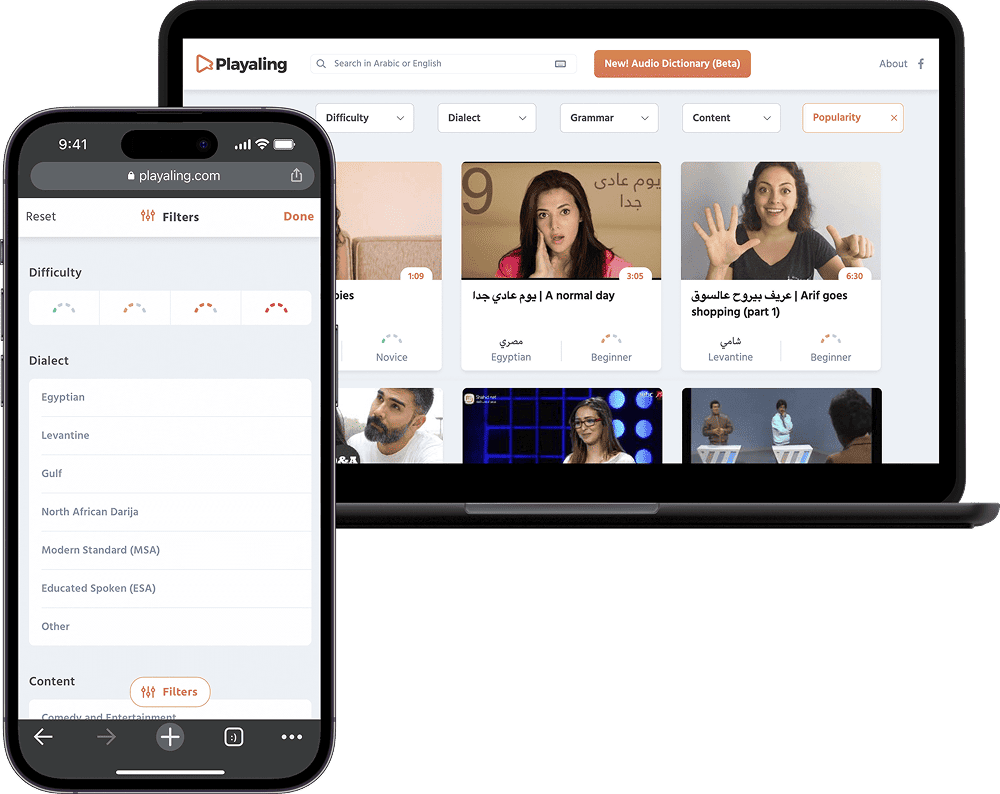
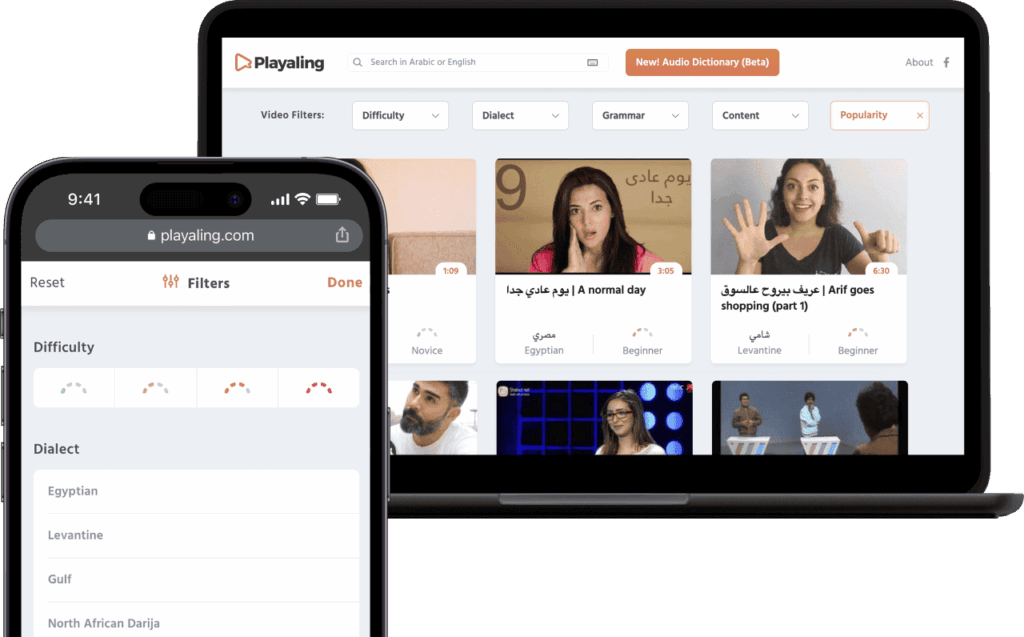
You can refine your video search based on your preferred level, content, grammatical concepts, popularity, dialect, and/or Modern Standard Arabic (MSA). Additionally, the text search function enables you to pinpoint specific vocabulary, themes, and functions with ease. Our innovative search algorithm provides maximum flexibility, ensuring you find precisely what you need. For detailed instructions on how to use the search function, simply click inside the search box.

If you’re a beginner, here are videos to learn Arabic letters and numbers:

If you already know the Arabic alphabet, you can explore these videos to expand your vocabulary:

If you wish to delve deeper and learn more about Arab culture, customs, traditions, and arts in Arab countries, there are many videos available, including:

Interactive captioning for every video

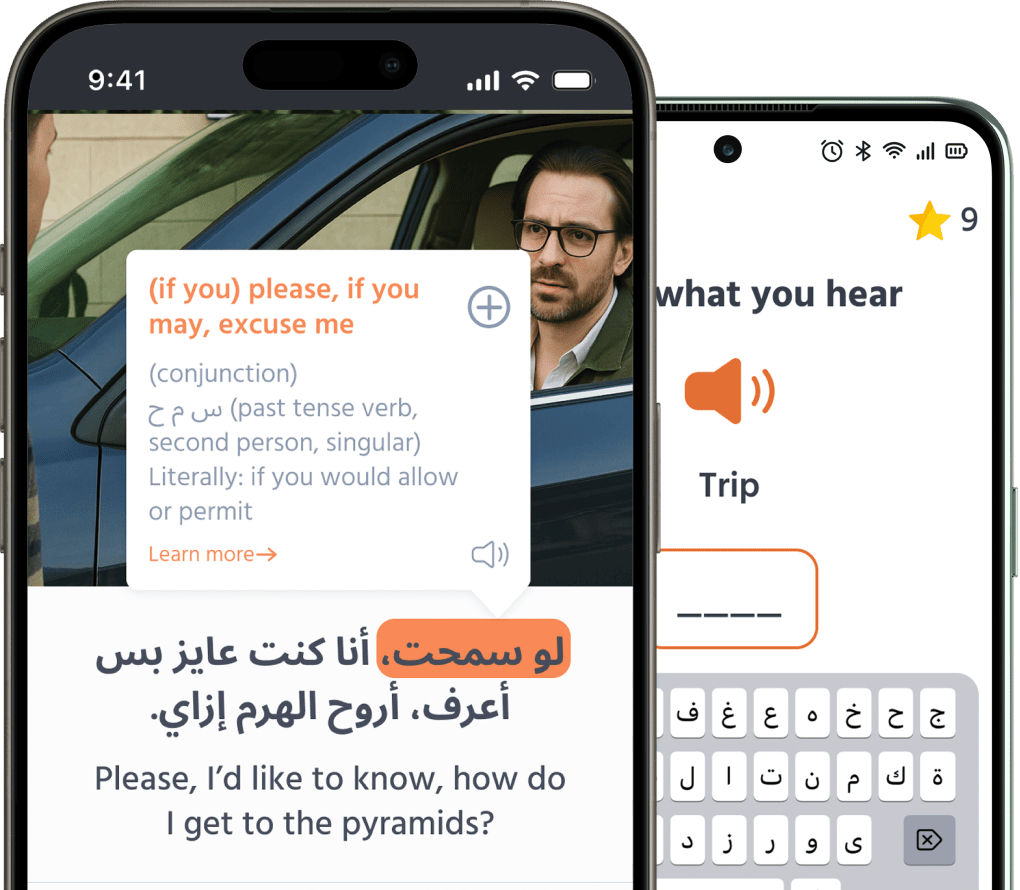
Playaling offers video translations, transcriptions, and a handy pop-up dictionary with definitions, audio pronunciation, and examples in context for every video.

A screenshot of Playaling's dictionary showing translations from English to MSA

With these features, you’ll learn from every video you watch, enjoying the exploration of each word, understanding its meaning, and discovering new ideas and cultures.


Cloze Listen activity

Engage in an activity designed to enhance your listening and writing skills by completing the sentences you hear. Fill in the missing words by typing them (if you have an Arabic keyboard) or selecting them from a word bank. To start, simply click the orange ‘Cloze Listen’ button after opening a video from the homepage.

Check Comprehension activity

Some videos feature a ‘Check Comprehension’ activity, designed to enhance your Modern Standard Arabic learning by allowing you to answer listening comprehension questions while watching the video. If this exercise is available for a video, an orange ‘Check Comprehension’ button will be visible when you open the video from the homepage.

Unique cross-dialectical Audio Dictionary

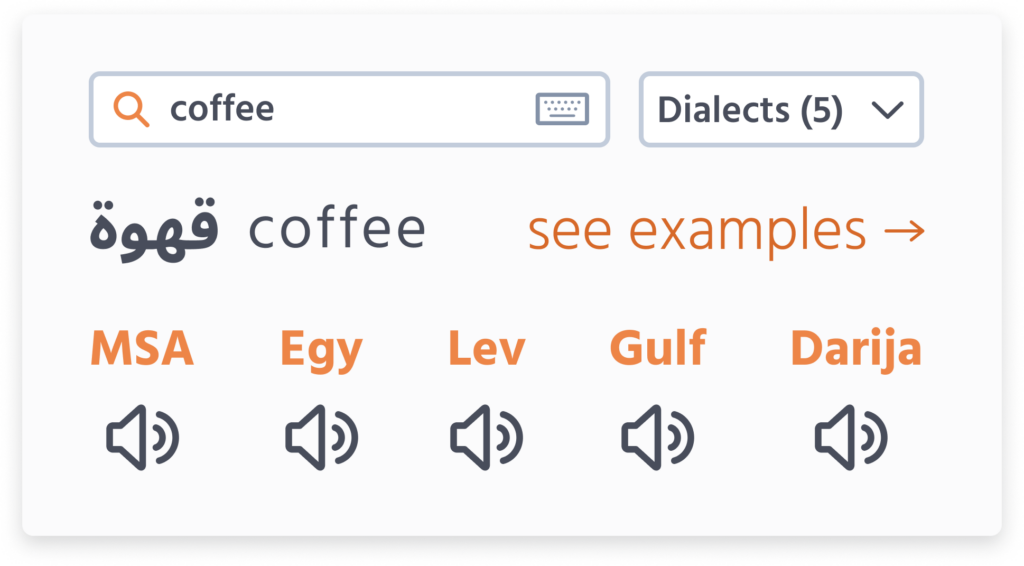
Should you need definitions for words or phrases, explore our distinctive cross-dialectical Audio Dictionary. Each entry features audio pronunciations, sample sentences, comprehensive grammatical details, and links to additional resources.

Interesting facts about Modern Standard Arabic

Here are some unique facts about Modern Standard Arabic:

  1. MSA is written from right to left, unlike English and other European languages, which are written from left to right. It shares this characteristic with Persian and Hebrew.
  2. MSA features sounds that are not present in many other languages, especially English and French, such as ح (ḥā’) (pharyngeal h), ظ (ẓāʾ) (emphatic th), and ض (ḍād) (emphatic d). This is why Arabic is sometimes referred to lughat al-ḍād (the language of ḍād).
  3. In MSA, when you have a basic set of few letters (root), like كَتَبَ (k-t-b) which means (wrote), you can use them to make other related words. For example, from كَتَبَ we get كِتَاب for (book) and مَكْتَب   for (office). So, in MSA, these few letters help us build many words related to the original meaning.
  4. MSA is one of the richest languages in the world, with at least 11 words for “love”, and more than 130 words for “lion”!

Why learn MSA (Modern Standard Arabic)?

Although never spoken as a native language, Modern Standard Arabic language is widely spoken and offers significant benefits for learners. If you’re interested in studying religions, it’s the language of the Quran and the primary language for practicing Islamic prayers and rituals, but also a principal liturgical language for several Christian churches in the Arab world.

For those interested in understanding Arab culture, learning Modern Standard Arabic is invaluable. It’s the official language of 25 countries: Algeria, Bahrain, Chad, Comoros, Djibouti, Egypt, Eritrea, Iraq, Jordan, Kuwait, Lebanon, Libya, Mauritania, Morocco, Oman, Palestine, Qatar, Saudi Arabia, Somalia, Sudan, Syria, Tanzania, Tunisia, United Arab Emirates and Yemen.

Arabic countries shown in a globe, each territory coloured in the appropriate Arab country color

If politics interest you, the Middle East cannot be ignored – and here Arabic is predominantly spoken and news is often broadcasted in Modern Standard Arabic


If you’re a travel enthusiast, you won’t want to miss iconic tourist destinations in the Arabic speaking world – the Pyramids in Egypt, the Burj Khalifa, the Museum of the Future in the United Arab Emirates, the city of Fes in Morocco, or the city of Baalbek in Lebanon, among many others. Learning MSA will undoubtedly enhance your experience in these Arabic regions.


As one of the six official languages of the United Nations, proficiency in Modern Standard Arabic (MSA) can open doors to careers in international organizations, diplomacy, journalism, tourism, and international trade.


Arabic is spoken by over 550 million people worldwide, making it the fourth most spoken language globally (after Chinese, English, and Spanish). Approximately 300 million consider it their native language, and about 250 million use it as a second language.


Arabic is a diverse language, with a distinction between Modern Standard Arabic (MSA), used in official settings, and the various spoken dialects, which vary widely across regions. Additionally, there is a minor distinction between Modern Standard Arabic and Classical Arabic, the language of the Quran.

However, Modern Standard Arabic provides a helpful foundation for understanding any Arabic dialect, making it useful to learn while exploring the dialects.


Begin your journey with us; Playaling is your premier choice for learning Modern Standard Arabic. With our carefully curated content, we aim to provide the best Arabic learning experience.


Experience Playaling’s features by exploring our website with a full week’s free access to all features, ensuring the finest experience while learning standard Arabic, colloquial Arabic, and Educated Spoken Arabic. Subscribe now and welcome aboard, ahlan wasahlan أهلًا وسهلًا 🤩”

Table of Contents

Popular MSA videos

Links

From Playaling's blog

Links

Master Arabic with real-world videos​

A fun and engaging way to boost your skills, discover rich culture, and learn how Arabs actually speak

Master Arabic with real-world videos​

A fun and engaging way to boost your skills, discover rich culture, and learn how Arabs actually speak

Trusted by

The University of Chicago
NYU Abu Dhabi

Trusted by

The University of Chicago
NYU Abu Dhabi

The best content in dialect and Modern Standard

We bring you real-world videos that are fun to watch, timely, and well-suited for Arabic learners.

Want to learn colloquial Arabic and/or Modern Standard Arabic (MSA)? Just started or aiming to take your skills to the next level? 

No matter your focus or skill level, our ever-growing library of 1000+ videos has all you need!

The best content in dialect and Modern Standard

We bring you real-world videos that are fun to watch, timely, and well-suited for Arabic learners.

Want to learn colloquial Arabic and/or Modern Standard Arabic (MSA)? Just started or aiming to take your skills to the next level? 

No matter your focus or skill level, our ever-growing library of 1000+ videos has all you need!

Understand the way Arabs actually talk​


All videos on Playaling are transcribed, translated, and equipped with our unique interactive captions that make real-world Arabic accessible to you. Hover over the interactive captions to discover each word’s meaning and pronunciation.

It’s more than just watching entertaining videos – it’s learning while having fun! 

Arabic video with interactive captions

Understand the way Arabs actually talk​

All videos on Playaling are transcribed, translated, and equipped with our unique interactive captions that make real-world Arabic accessible to you. Hover over the interactive captions to discover each word’s meaning and pronunciation.

It’s more than just watching entertaining videos – it’s learning while having fun! 

Good job

Build real-world Arabic skills, fast

Expand your vocabulary, reinforce grammar, and develop a natural feel for the language.

You’ll learn through smart, interactive activities built around authentic content and powered by cutting-edge tech. The result? Practice that’s effective, intuitive, and actually fun to stick with.

Good job

Build real-world Arabic skills, fast

Expand your vocabulary, reinforce grammar, and develop a natural feel for the language.

You’ll learn through smart, interactive activities built around authentic content and powered by cutting-edge tech. The result? Practice that’s effective, intuitive, and actually fun to stick with.

See it. Hear it. Master it.

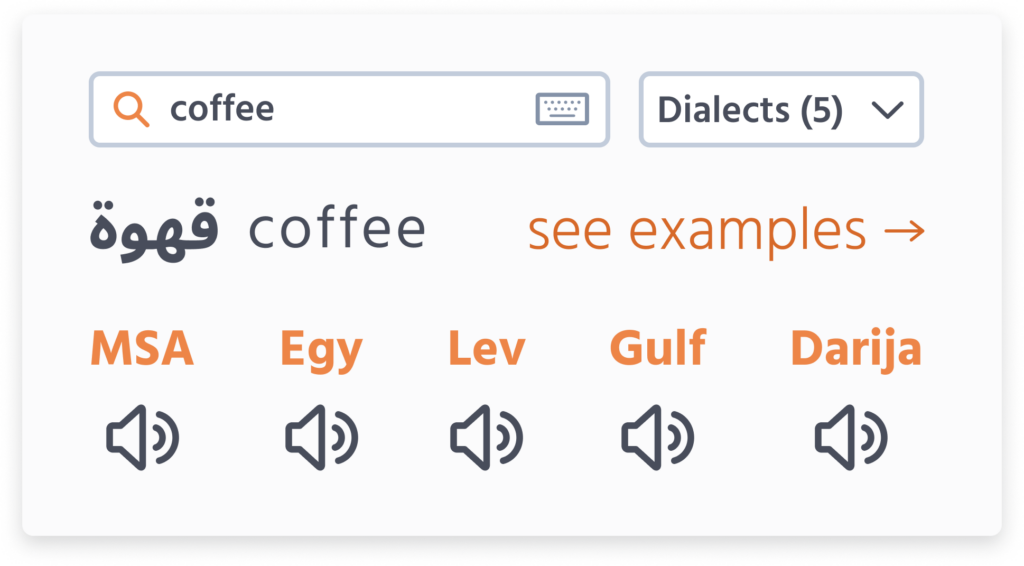
Never wonder how to say a word or use it in context. Our Audio Dictionary is the only Arabic dictionary that combines human voice pronunciation, grammar tips, and real-world example sentences (with audio), all in one place.

It’s everything a dictionary should be, finally designed for Arabic learners—no matter what variety of Arabic you’re learning.

Audio Dictionary
Audio Dictionary

See it. Hear it. Master it.

Never wonder how to say a word or use it in context. Our Audio Dictionary is the only Arabic dictionary that combines human voice pronunciation, grammar tips, and real-world example sentences (with audio), all in one place.

It’s everything a dictionary should be, finally designed for Arabic learners—no matter what variety of Arabic you’re learning.

Alphabet course

New to Arabic?

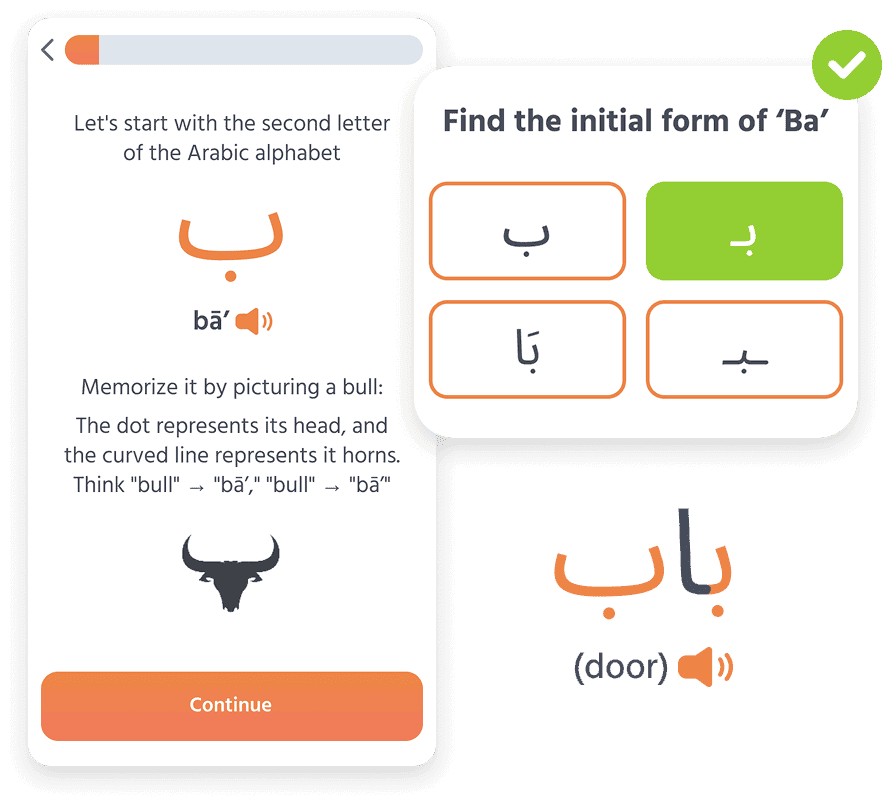
Our alphabet course will take you from zero to reading, step by step. Each lesson introduces letters with clear pronunciation, explains how they connect, and shows them in real words you’ll start to recognize and learn.

Short lessons, built-in review exercises, and audio for every letter — so you build a solid foundation without the struggle.

Alphabet course

New to Arabic?

Our alphabet course will take you from zero to reading, step by step. Each lesson introduces letters with clear pronunciation, explains how they connect, and shows them in real words you’ll start to recognize and learn.

Short lessons, built-in review exercises, and audio for every letter — so you build a solid foundation without the struggle.

Learn anytime, anywhere — with our app

Access our core features, plus the app-exclusive WordPractice™, a smarter review tool that reinforces the words, phrases, and patterns you’ve encountered.

Powered by spaced repetition and active recall, it helps you internalize what you’re learning in context and remember it long term, far beyond what flashcards can offer.

Learn anytime, anywhere — with our app

Access our core features, plus the app-exclusive WordPractice™, a smarter review tool that reinforces the words, phrases, and patterns you’ve encountered.

Powered by spaced repetition and active recall, it helps you internalize what you’re learning in context and remember it long term, far beyond what flashcards can offer.

Quote

“Playaling is a revolutionary, one-of-a-kind tool for learning Arabic. I can’t give it enough praise.”

Hossam Abouzahr, The Living Arabic Project

Playaling vs. traditional methods

With Playaling

Without Playaling

Real-world videos
Immerse yourself in authentic Arabic through real-world videos, helping you understand cultural nuances and practical language use

Limited exposure
Struggle to understand real Arabic conversations and miss out on the rich cultural context due to a lack of real-world content

Audio Dictionary
Instantly look up words with our Audio Dictionary, ensuring you learn the correct pronunciation from native speakers

Pronunciation challenges
Rely on text-only dictionaries that don’t help you with pronunciation, leading to potential misunderstandings

Videos in different dialects
Learn not just Modern Standard Arabic, but also delve into various dialects like Levantine, Egyptian, and Gulf, making your learning experience comprehensive and versatile

Dialect confusion
Get lost among various dialects without guidance, making it difficult to  communicate effectively and efficiently across different Arabic-speaking regions

Interactive exercises
Strengthen your skills with engaging exercises tailored to your learning level, ensuring you apply what you’ve learned effectively

Inconsistent practice
Find it hard to retain new knowledge without structured exercises, leading to slower progress and frustration

Interactive captions
Follow along with detailed transcriptions of each video, helping you connect spoken Arabic with its written form, enhancing both your listening and reading skills

Fragmented learning
Experience gaps in understanding when you can’t follow along with spoken content due to the absence of detailed captioning, making it harder to connect spoken and written Arabic

Playaling vs. Traditional Methods

With Playaling

Real-World Videos
Immerse yourself in authentic Arabic through real-world videos, helping you understand cultural nuances and practical language use

Audio Dictionary
Instantly look up words with our Audio Dictionary, ensuring you learn the correct pronunciation from native speakers

Videos in Different Dialects
Learn not just Modern Standard Arabic, but also delve into various dialects like Levantine, Egyptian, and Gulf, making your learning experience comprehensive and versatile

Interactive Exercises
Strengthen your skills with engaging exercises tailored to your learning level, ensuring you apply what you’ve learned effectively

Interactive Captions
Follow along with detailed transcriptions of each video, helping you connect spoken Arabic with its written form, enhancing both your listening and reading skills

Without Playaling

Limited Exposure
Struggle to understand real Arabic conversations and miss out on the rich cultural context due to a lack of real-world content

Pronunciation Challenges
Rely on text-only dictionaries that don’t help you with pronunciation, leading to potential misunderstandings

Dialect Confusion
Get lost in the different dialects without guidance, making it difficult to communicate effectively in various Arabic-speaking regions

Inconsistent Practice
Find it hard to retain new knowledge without structured exercises, leading to slower progress and frustration

Fragmented Learning
Experience gaps in understanding when you can’t follow along with spoken content due to the absence of detailed captioning, making it harder to connect spoken and written Arabic

What people say about us

Learn Arabic without a struggle

“This is love at first video. I never thought that learning Arabic could be so fun and interesting! It’s only been a month using Playaling and my teacher has already noticed my progress and new words I’m using.”

Linda Moore

Linda Moore

Latest posts